Guardrail crash testing measures how a full-size barrier holds up when struck by a set weight.
A vehicle or impactor strikes at a measured speed and angle. Instruments record the force and how far the barrier moves. Engineers then check whether the fixings and the slab hold.
AS/NZS 1170.1 sets the impact load a barrier must resist. But there’s more to crash testing than ratings and compliance, especially when you’re working on a project.
In today’s guide, we’ll cover crash test methods for guardrails, the 30 kN, 40 kN and 240 kN ratings, and how to read a test report before you specify.
What Does a Guardrail Crash Test Actually Prove?
A crash test provides evidence that a specific barrier configuration, when installed as tested, resists a defined impact.
A design load on paper is a calculation. A test demonstrates performance. Post spacing, rail profile, base plate, anchors and substrate all form part of the result. Change any of them, and the result may not carry over.
Substituting a fixing or using a thinner slab edge creates a different barrier setup than the one tested. For more on regulatory requirements, see our guide on where vehicle barriers are required; crash test evidence confirms whether a specific system meets that duty.
What Are the Main Ways Vehicle Barriers are Tested?
Three methods are in use, and good suppliers combine more than one.
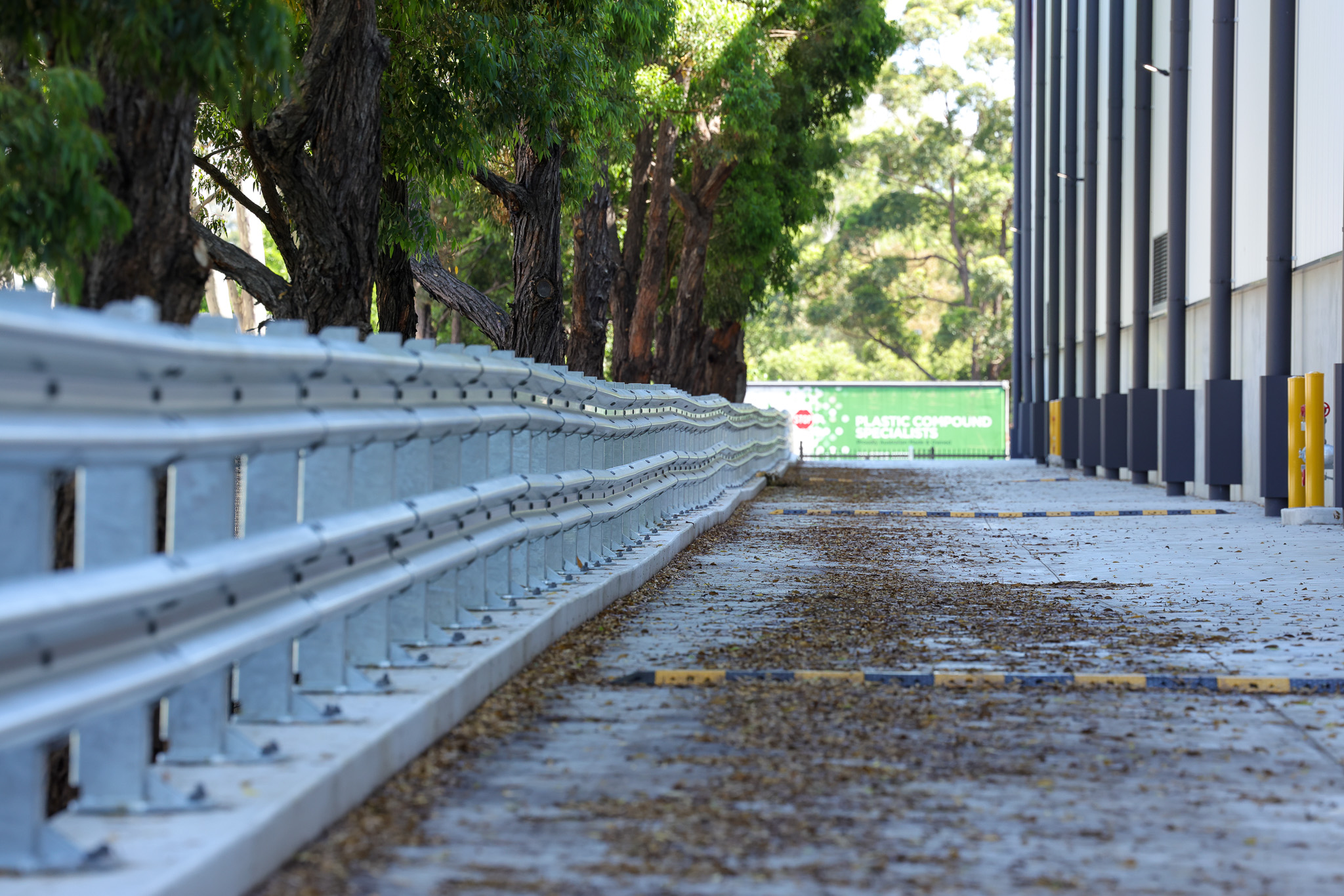
Static load testing. A hydraulic ram pushes on the rail at design height until it reaches the rated kN load. It checks posts, fixings and anchors. It cannot show dynamic deflection, because a real vehicle arrives at speed.
Dynamic impact testing. A test vehicle, weighted pendulum or bogie strikes the barrier at a set speed and angle. This is the true crash test. It produces the deflection figures.
Engineering calculation and modelling. Structural calculations or finite element models extend tested results to variations such as different spans. A model is only as reliable as the physical test it is calibrated against.
What Happens During a Crash Test?
A crash test follows a fixed sequence, from slab preparation to inspection after impact.
The barrier is installed on a concrete slab representative of the intended installation conditions. During testing, the mass of the vehicle or impactor is confirmed, and its speed is measured immediately before impact. In accordance with the AS/NZS 1170.1 impact requirements, the impact is applied at 90 degrees (perpendicular) to the barrier. High-speed cameras and specialised measuring equipment record the impact, allowing engineers to assess the barrier’s performance, deflection and structural integrity.
Following the impact, engineers assess the barrier’s performance by measuring its maximum dynamic deflection and permanent deformation. The barrier, welds, fixings and supporting concrete slab are inspected for signs of damage, cracking or anchor failure. Independent testing by a NATA-accredited facility provides additional confidence in the reliability of the results. Guard-R’s Kwik-Guard® barriers have undergone independent crash testing by APV Engineering and Testing Services (APV-T), a NATA-accredited testing facility.
What Do 30 kN, 40 kN, and 240 kN Ratings Mean?
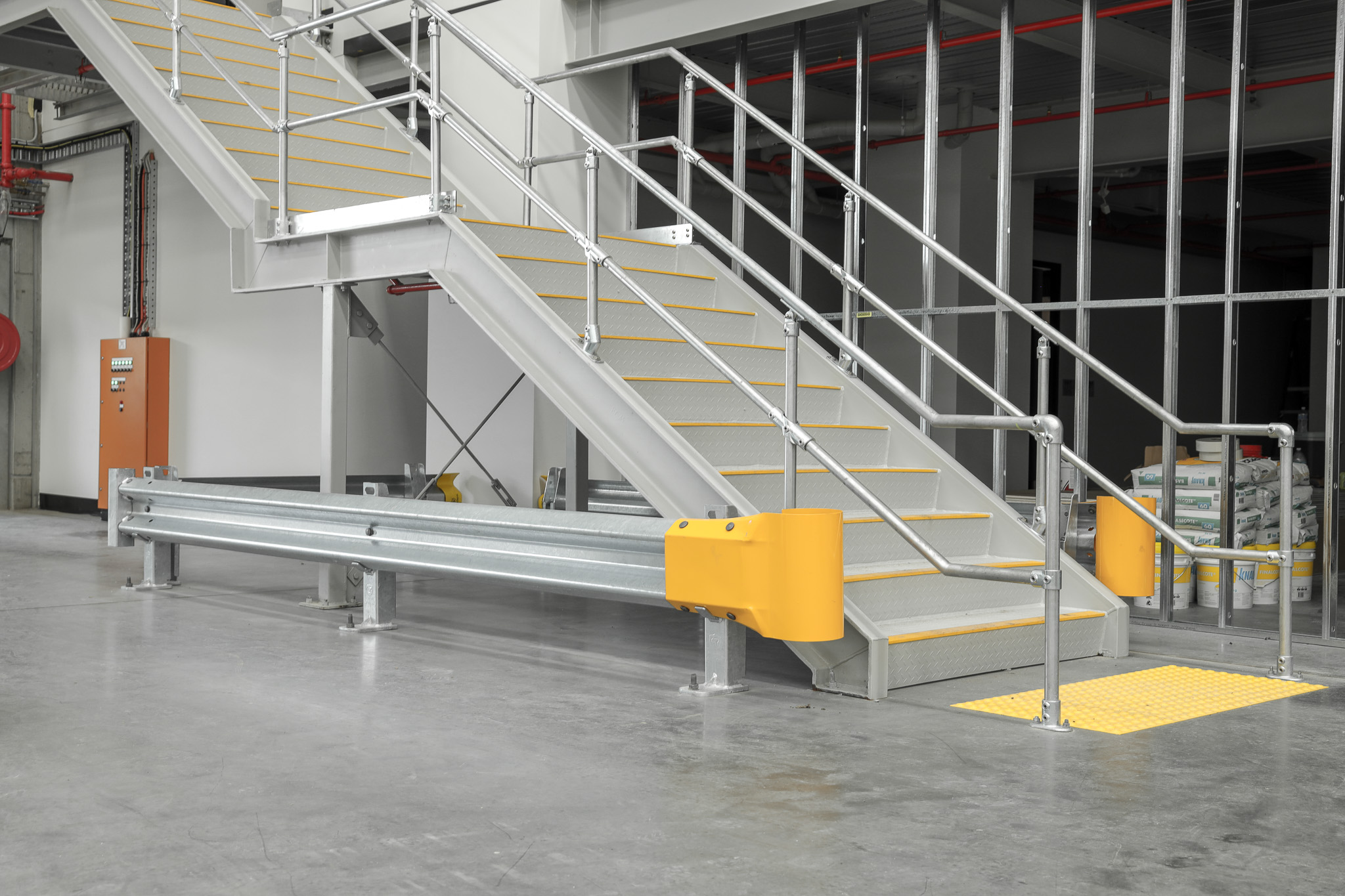
These are the design impact loads in AS/NZS 1170.1 Clause 3.8, matched to where a barrier sits in the car park.
Location | Traffic Type | Design Load | Kwik-Guard Range |
General parking areas | Light traffic (Type F) | 30 kN | Kwik-Guard Single Height 30 kN, op or edge mount |
Areas with heavier vehicles | Medium traffic (Type G) | 40 kN | Kwik-Guard Double Height 40 kN Top Mount |
End of straight downward ramps longer than 20 m | Ramp runout | 240 kN |
The 240 kN impact load is significantly higher than the standard 30 kN and 40 kN car park barrier ratings. This higher load requirement applies to certain straight downward ramps exceeding 20 metres in length, where vehicles have the potential to gain additional speed and generate greater impact forces. Guard-R’s 240 kN Kwik-Guard® ramp barrier is specifically designed for these high-impact applications, providing a crash-tested solution for the applicable design requirements.
Roadside safety barriers are assessed under AS/NZS 3845.1 and Austroads guidelines, while some polymer warehouse barriers use PAS 13 joule ratings. Note that joule ratings do not convert directly to kN car park ratings
Our comparison of VicRoads Type D vs AS/NZS 1170.1 explains that gap.
How Do You Verify a Guardrail's Crash Test Performance?
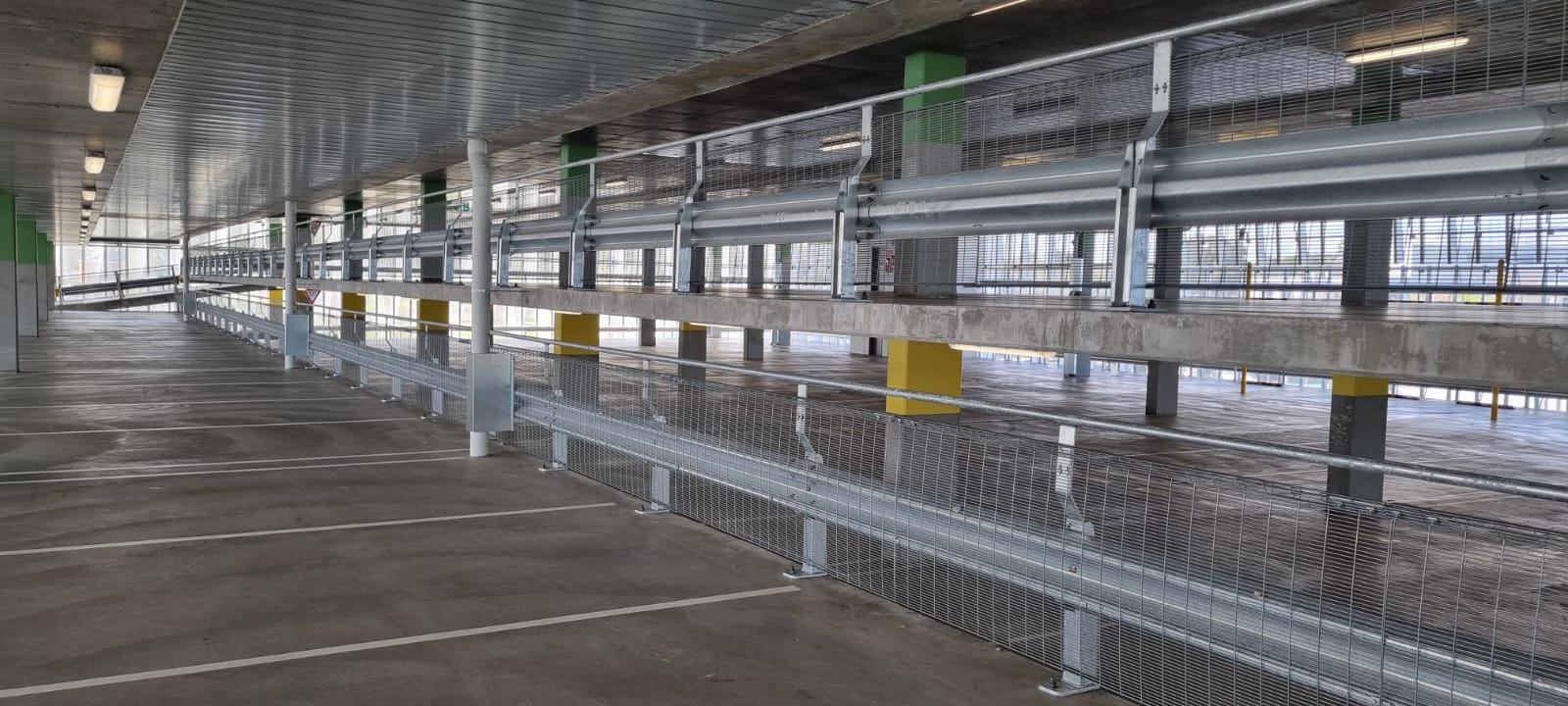
When selecting a crash-tested guardrail system, it’s important to look beyond the advertised impact load and confirm that the barrier has been independently tested to the relevant Australian Standards.
Here are four key factors to consider when evaluating a guardrail system.
- Independent Crash Test Certification
Request evidence that the guardrail has undergone independent crash testing by a recognised testing facility.
Guard-R’s Kwik-Guard® barriers have been independently crash tested by APV Engineering and Testing Services (APV-T), a NATA-accredited testing facility.
- Impact Load Rating
Confirm that the barrier’s certified performance is suitable for the intended application and relevant design requirements under AS/NZS 1170.1.
Guard-R offers Kwik-Guard® systems with 30 kN, 40 kN and 240 kN impact load ratings for applicable car park environments.
- Barrier Configuration and Installation
The performance of a guardrail depends on its configuration, including post spacing, mounting arrangement, fixings and supporting structure.
Whether specifying a top-mounted or edge-mounted guardrail, ensure the proposed installation is consistent with the certified system and relevant engineering requirements.
- Certification and Technical Documentation
A reputable supplier should be able to provide independent crash test certification and relevant technical documentation to support product selection and specification.
Guard-R provides independent crash test certificates, product specifications, installation details and engineering information for its Kwik-Guard® range, helping architects, engineers and builders select an appropriate vehicle barrier system.
What Should You Ask a Supplier Before Specifying?
Before specifying a vehicle barrier system, it’s important to confirm that the product meets the relevant Australian Standards and is suitable for your project’s design requirements.
Here are five key questions to ask your guardrail supplier:
- Has the barrier been independently crash tested? Confirm which testing facility conducted the testing and whether independent certification is available. Testing by a NATA-accredited facility provides additional confidence in the reliability and credibility of the results.
- What impact load rating does the barrier achieve? Verify that the system’s certified 30 kN, 40 kN or 240 kN performance is appropriate for the intended application under AS/NZS 1170.1.
- Is the barrier suitable for my installation requirements? Check that the post spacing, mounting configuration, fixings and supporting structure are consistent with the certified system and applicable engineering requirements.
- Can you provide independent crash test certification? Request certification confirming the barrier’s tested performance and applicable impact load rating.
- Is technical documentation available? Ensure the supplier can provide product specifications, installation details, CAD drawings and BIM/Revit resources to support design and specification.
Frequently Asked Questions
Is crash testing required by Australian Standards?
No. AS/NZS 1170.1 sets the impact load a car park barrier must resist but does not mandate a crash test. Independent testing is the clearest evidence a barrier meets that load, and certifiers value it.
What is the difference between static and dynamic testing?
Static testing applies a slow load to the rail until it reaches the rated load. Dynamic testing strikes the barrier with a moving mass. It shows deflection and whether the fixings hold in a real impact.
What is a good deflection result for a car park barrier?
Lower is better, especially at slab edges or besides walkways. Compare deflection against the clear space behind the barrier. Kwik-Guard Single Height 30 kN recorded a maximum dynamic deflection of 101 mm.
Who carries out guardrail crash testing in Australia?
Independent laboratories accredited by NATA carry out the testing. Guard-R’s Kwik-Guard range was tested by APV Engineering and Testing Services (APV-T), a NATA accredited facility.
Does a crash-tested barrier stay compliant if I change the installation?
No, not automatically. Results apply to the tested configuration. Changing post spacing, fixings or substrate needs engineering review to confirm the barrier still meets the design load.
Choosing the Right Barrier for Your Project
For most multi-storey car park applications, an engineered guardrail gives you the more practical specification. You get defined load options, less structural weight, faster installation, and a barrier that can be repaired in sections after an impact.
Concrete still has its place. Use it where site conditions, structural design, or heavy vehicle traffic demand a solid barrier.
Guard-R’s technical team can review your application and help identify the appropriate Kwik-Guard® configuration for the required load and installation condition. Spec sheets, CAD details and BIM and Revit resources are also available for project documentation.