
Pedestrian fencing is one of the most important — and most underestimated — safety systems used in modern road infrastructure.
At Guard-R Group, we view pedestrian fencing not as a simple roadside product, but as a critical engineered safety treatment that directly influences pedestrian behaviour, roadside risk exposure, driver predictability, and overall network safety performance.
As transport authorities and road designers continue adopting Safe System principles across Australia, pedestrian fencing has become an essential component of safer road corridor design.
s road networks become busier and urban environments more complex, pedestrian safety has become one of the most important considerations in modern infrastructure design.
For road engineers, designers, and transport authorities, pedestrian fencing is no longer viewed as optional roadside infrastructure — it is an essential safety system that plays a critical role in protecting vulnerable road users and improving the overall safety performance of road corridors.
Across Australia, pedestrian fencing is now widely incorporated into road designs as a mandatory safety measure in high-risk pedestrian environments including school zones, transport interchanges, intersections, medians, shared paths, bridges, and high-traffic urban corridors.
At the forefront of this space is Guard-R Group’s Street-Guard® pedestrian fencing system, designed to provide compliant, durable, and highly effective pedestrian protection solutions for modern transport infrastructure.
Safe System Design Requires Physical Separation
The Safe System approach recognises a simple reality: people make mistakes.
Road infrastructure must therefore be designed to minimise the likelihood that those mistakes result in serious injury or death.
This is where pedestrian fencing plays a critical role.
Rather than relying purely on signs, line marking, or behavioural compliance, pedestrian fencing provides physical separation between vulnerable road users and live traffic environments.
It is one of the most effective tools available to:
- Prevent uncontrolled road crossings
- Guide pedestrians toward protected crossing locations
- Reduce pedestrian exposure to traffic
- Improve driver awareness and predictability
- Support safer traffic flow
- Protect vulnerable road users in high-risk areas
For this reason, pedestrian fencing is now widely incorporated into road authority standards, Safer Roads programs, urban corridor upgrades, and transport infrastructure projects throughout Australia.
Why Pedestrian Fencing Is Mandatory in Modern Road Design
In many modern road environments, pedestrian fencing is no longer optional.
Where pedestrian activity, traffic speeds, vehicle volumes, or roadside risk levels are elevated, fencing becomes a necessary safety control to achieve the intended Safe System outcome.
Road designers must consider how pedestrians interact with traffic environments in real-world conditions — not ideal conditions.
Without physical guidance, pedestrians naturally seek the shortest or most convenient path, often resulting in unsafe crossing behaviour.
Pedestrian fencing helps eliminate this unpredictability by creating controlled pedestrian pathways and directing users toward designated crossing facilities.
This is particularly critical in:
- School zones
- Urban arterial roads
- Public transport interchanges
- Rail corridors
- Signalised intersections
- Median refuges
- Shopping precincts
- Shared pathways
- Bridge approaches
- High pedestrian activity corridors
At Guard-R Group, we believe pedestrian fencing should be treated as a mandatory design consideration wherever vulnerable road users are exposed to live traffic risks.
Good Pedestrian Fencing Design Goes Beyond Compliance
Not all pedestrian fencing performs equally.
Poorly designed fencing can create secondary roadside hazards if impact behaviour, offsets, sightlines, or pedestrian movement patterns are not properly considered during design.
At Guard-R Group, we closely follow Safe System design principles and recognised roadside safety guidance relating to pedestrian fencing performance.
This includes critical considerations such as:
- Vehicle impact exposure
- Offset distances from traffic lanes
- Fence failure behaviour
- Pedestrian entrapment risk
- Spearing hazards
- Sightline preservation
- Pedestrian desire lines
- Safe refuge areas
- Access and escape points
These are not minor details — they are fundamental to whether a fencing system contributes positively to roadside safety outcomes.
Pedestrian fencing should always be designed as part of the overall roadside safety environment, not treated as isolated roadside furniture.

The Importance of Pedestrian Behaviour Management
One of the most overlooked aspects of pedestrian fencing is behavioural control.
Effective road design is not only about infrastructure strength — it is about influencing how people move through environments.
Well-positioned pedestrian fencing helps create safer and more predictable pedestrian behaviour by discouraging random crossings and reinforcing designated movement paths.
This significantly improves safety performance in environments where pedestrians may otherwise make unsafe crossing decisions.
The result is:
- Improved crossing discipline
- Reduced pedestrian conflict points
- Better driver anticipation
- Improved traffic efficiency
- Lower roadside risk exposure
For engineers and designers, pedestrian fencing becomes a critical behavioural safety tool — not simply a barrier system.
How the Safe System Methodology Connects with Pedestrian Fencing
The Safe System methodology is built on a simple but critical principle: people make mistakes, and road infrastructure must be designed so those mistakes do not result in death or serious injury.
Rather than relying solely on driver behaviour, signage, or enforcement, the Safe System approach focuses on designing safer roads that physically reduce risk exposure and minimise conflict between vulnerable road users and vehicles.
This is where pedestrian fencing plays a critical role.
Pedestrians are among the most vulnerable users within any transport network. Unlike vehicle occupants, pedestrians have little physical protection in the event of a collision. Safe System road design therefore prioritises reducing direct interaction between pedestrians and live traffic wherever possible.
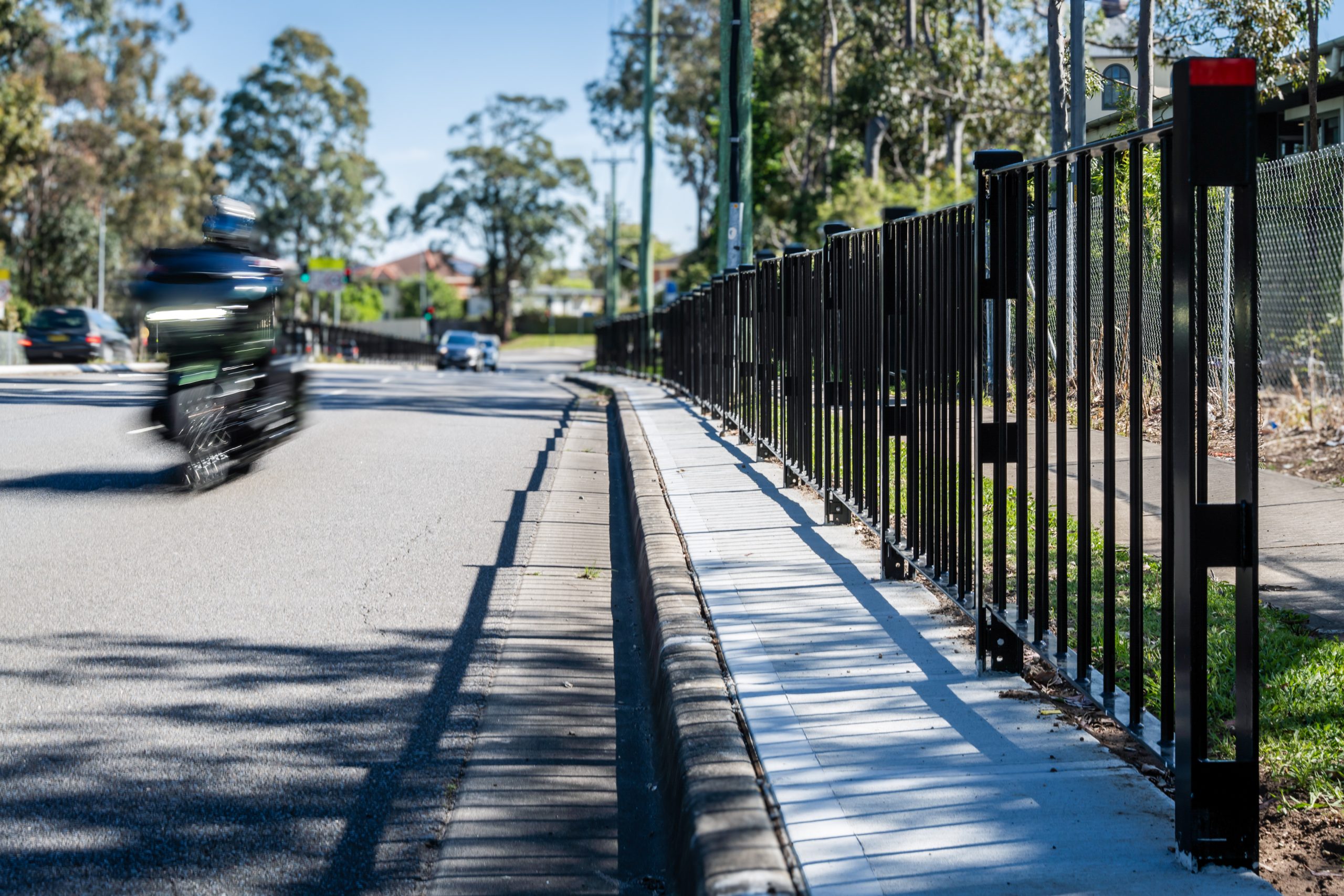
Under Safe System principles, pedestrian fencing is not simply roadside furniture — it is a behavioural safety control that actively influences how people move through high-risk traffic environments.
Effective pedestrian fencing helps:
- Reduce uncontrolled road crossings
- Improve pedestrian discipline
- Support safer crossing behaviour
- Reduce roadside conflict points
- Improve driver predictability
- Protect vulnerable road users
- Improve overall corridor safety performance
The methodology also recognises that infrastructure must be forgiving when mistakes occur. This means pedestrian fencing should be carefully designed with roadside safety performance in mind, including appropriate offsets, visibility, impact exposure, and failure behaviour.
As governments and transport authorities continue prioritising Safer Roads programs across Australia, pedestrian fencing remains one of the most effective physical safety measures available to road engineers and designers working to deliver safer communities.
Build Safer, More Reliable Carparks – On Time & On Spec
Explore car carpark solutions on our website or book a no-obligation consultation to discuss how Guard-R can help you design safer, compliant carpark environments that stand the test of time.